

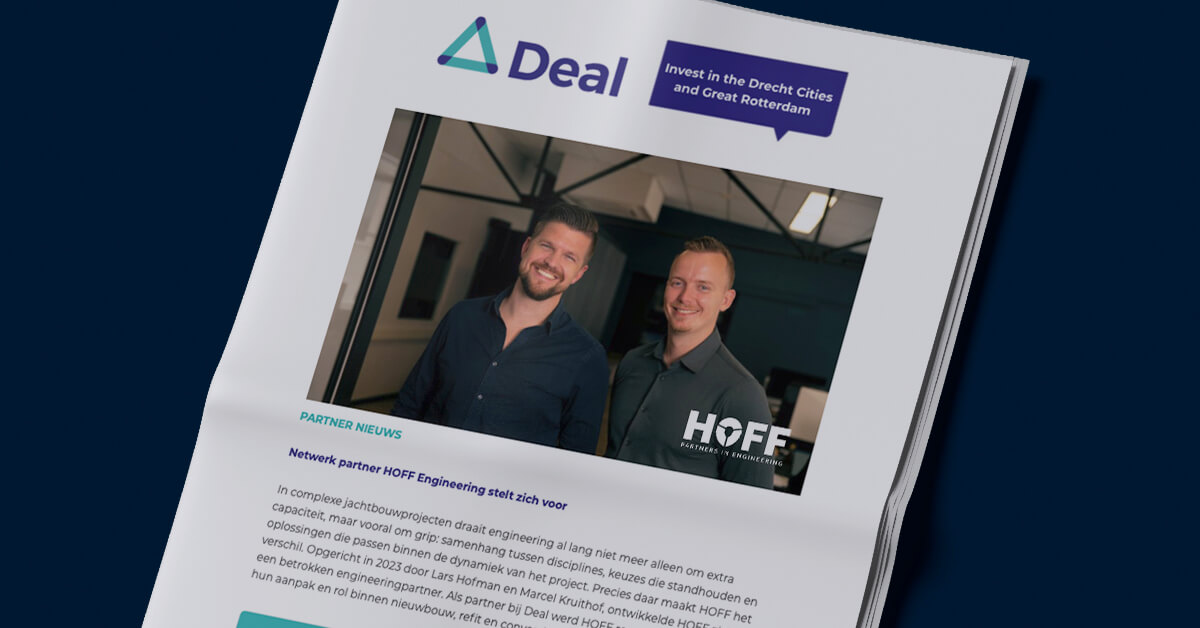
Read the interview in Dutch here.
Deal recently interviewed Lars Hofman and Marcel Kruithof about HOFF, the future of the maritime sector, and the role engineering plays in keeping complex yacht and shipbuilding projects on track.
HOFF • Partners in Engineering: Reliable yacht and ship engineering that brings clarity
In complex yachtbuilding projects, engineering has long since become about more than adding capacity. Yards and suppliers are looking for control over how disciplines connect, whether decisions will hold up in later phases, and whether the engineering actually fits the reality of the project. That is where HOFF makes a difference.
Founded in 2023 by Lars Hofman and Marcel Kruithof, HOFF was built around hands on experience in the luxury yacht sector. The company was not set up as a distant consulting layer, but as an engineering partner that works in step with the yard, the project team, and the demands of execution. Today, HOFF supports yards and suppliers in newbuild, refit, and conversion projects with a growing team.
What sets HOFF apart is the combination of technical depth and project level oversight. The team fits into existing systems and ways of working, while keeping sight of the bigger picture: how disciplines affect one another, where interfaces are vulnerable, and which decisions will matter later in the process. That takes more than drafting capacity. It takes engineering that brings clarity.

Could you briefly introduce yourselves?
HOFF is an engineering partner for yards and suppliers in the maritime sector, with a strong focus on luxury yachtbuilding. In newbuild, refit, and conversion projects, HOFF works as an extension of the client organization. The company understands how planning, decision making, and engineering come together in a live yard environment.
That way of working is closely tied to the background of founders Lars Hofman and Marcel Kruithof. Both have worked closely with complex yachtbuilding projects and understand how much depends on clear starting points, strong coordination, and engineering that looks beyond a single discipline.
“A ship is essentially a self contained floating mini city. Everything comes together in it,” says Lars Hofman. “Once it is clear who needs what and when, you get control. That is what HOFF helps yards achieve with sound engineering that already takes the next phases into account.”
Because HOFF consistently connects technical work to overall project coherence, clients know what they are bringing the company in for. It is not only engineering expertise, but also structure and oversight when projects come under pressure. In practice, that means questions like these: are the interfaces clear, are bottlenecks visible early enough, and can the next phase build confidently on what is being defined now?
Why do clients specifically choose HOFF • Partners in Engineering?
Clients choose HOFF because the company does more than fill a temporary capacity gap. HOFF adapts to the yard’s way of working, understands the reality of the project, and delivers engineering that is technically strong and usable in practice.
In concrete terms, that starts with a solid intake. HOFF does not step in blindly. The first priority is understanding what the project actually requires, where the pressure is, which decisions are already fixed, and where the main risks or uncertainties sit. From there, the team can integrate quickly and set up the work properly. That foundation matters in every project, and even more when the pressure is already high.
The difference often lies in how the project is approached. Not discipline by discipline, but as an integrated whole. Buildability, access for maintenance, system logic, and phase transitions are considered early. That reduces noise in coordination and creates more predictability in the phases that follow.
Clients also value the way HOFF works with them. Professional where needed, informal where possible. Transparent about decisions, clear about assumptions, and steady when pressure builds. For many clients, that weighs just as heavily as technical quality.
Where does HOFF • Partners in Engineering’s expertise lie?
The core of HOFF’s work is Basic Engineering. This is where the technical foundation of a project is established: system architecture, main routing principles, interfaces between disciplines, and the spatial starting points that will later drive detail engineering and production.
For HOFF, Basic Engineering is not a standalone middle phase. It is the point at which a design needs to become buildable, logical, and transferable.
“Basic Engineering is the foundation,” says Marcel Kruithof. “That is where a design becomes truly buildable from a technical standpoint. It is not just about whether something fits. It is about whether it can be built logically, maintained properly, and made to work across disciplines. That multidisciplinary aspect is exactly what makes it interesting.”
From that foundation, HOFF also supports clients in Concept Design Engineering, Detail Engineering, Pipe Routing and System Diagrams, Structural Drawings, Net Space Definition, Mechanical Engineering, Procurement Engineering, and Advanced Engineering based on 3D measurements. These services support the technical development, integration, and project coordination work that often determines whether a project moves forward smoothly or stalls under pressure.
What course do you want to chart in the coming years?
Over the next few years, HOFF aims to further strengthen its position as an engineering partner in the luxury yacht sector. That direction builds on what the company is already known for: technical depth, multidisciplinary oversight, and a way of working that aligns with the processes of yards and suppliers. Robust Basic Engineering will remain a key focus.
At the same time, HOFF sees opportunities to apply its knowledge and experience more broadly in other maritime segments facing similar challenges around system integration, buildability, engineering pressure, and phase transitions. The principle remains the same: not a remote advisory role, but hands on technical support that can be applied directly within the project.

When do you consider a collaboration truly successful?
For HOFF, a collaboration is successful when the impact is noticeable on the floor and in the course of the project. Sometimes that shows up in efficiency. Sometimes in better control over the engineering process. Sometimes in fewer revisions, or in decisions that remain solid later in the build.
Just as important is trust. A yard or supplier needs to feel that the work is in good hands. That there is less chasing, less re-explaining, and less unnecessary complexity. Engineering should not add friction. It should help create clarity.
A large part of HOFF’s value lies there. When a client feels that the work is under control, that the team is thinking along, and that things do not need to be explained over and over again, it creates room to keep moving. That is when collaboration becomes real support. In the end, a ship is built together.
Which question is not being asked often enough in the sector today, even though it is essential for the future?
An important question for the sector is how to maintain the highest level of quality while still allowing every discipline and stakeholder to contribute effectively within increasingly complex projects.
A yacht is never built by one discipline alone. The final result comes from the interaction between design, engineering, production, suppliers, and project coordination. That is why clear roles matter, assumptions need to be made explicit, and technical decisions cannot be made in isolation. A great deal of project risk emerges precisely where that overall coherence remains implicit.
As Lars sees it, quality starts not only with technical execution, but also with how people work together. When the overall structure is organized properly, problems are less likely to surface only when the room to respond has already narrowed.

How do you experience the collaboration with Deal?
HOFF has been a network partner of Deal since late last year and sees the collaboration as a valuable one. What stands out in particular is the accessible way Deal creates connections across the maritime sector.
Through the network, HOFF comes into contact with professionals and companies that might otherwise be harder to reach through the usual channels. That makes the partnership valuable not only in terms of relationship building, but also in terms of knowledge exchange and sector insight. The maritime industry remains a sector where cooperation, specialist expertise, and mutual understanding carry real weight. A network that helps strengthen those connections in a practical and approachable way makes a meaningful contribution.
Source: Deal


More articles