

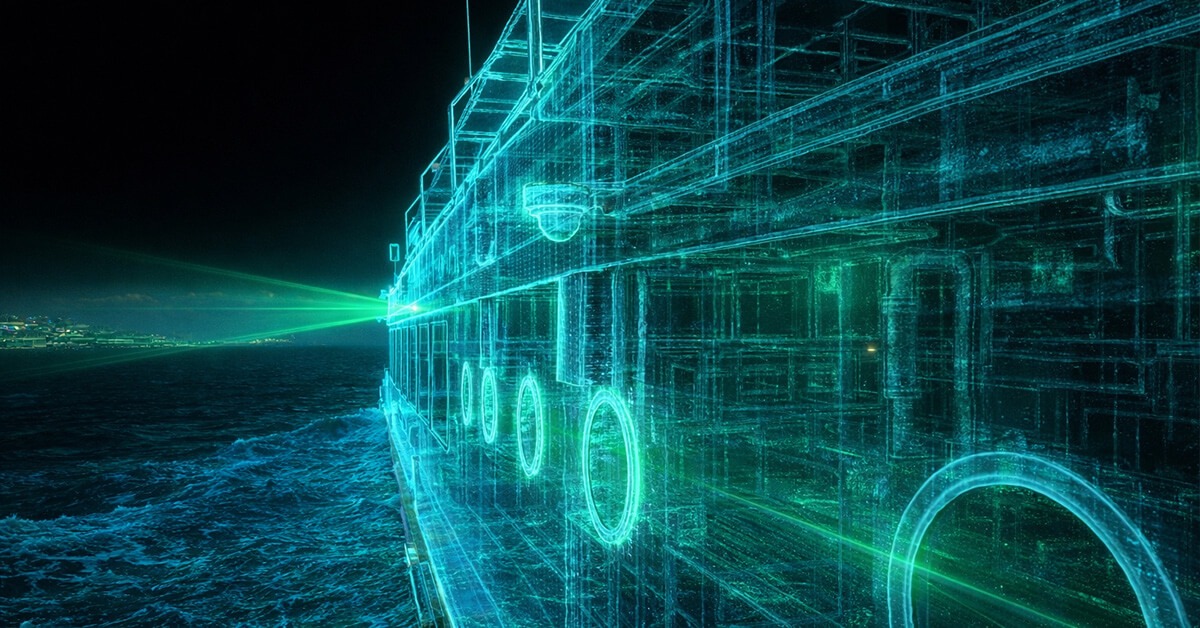
Refit and conversion projects often start from existing drawings, if they are available at all. These provide direction, but in practice, and this is widely recognised on the yard, the onboard situation can differ significantly.
Previous modifications play a role, but so do construction deviations or decisions made during the original installation. In some cases, usable drawings are limited or missing entirely, making it necessary to capture the actual situation from the outset.
In refit, the question is therefore rarely whether reality deviates from drawings, but when it becomes worthwhile to capture that reality more accurately and how to continue engineering from that point in a structured way.
Why Existing Drawings Are Not Always Sufficient
Existing drawings in refit projects are often a useful starting point, but they rarely reflect the full picture. They represent the original configuration or a previous revision, while vessels tend to evolve over time.
As a result, discrepancies arise between drawings and the actual situation. Piping may run differently, structure may have been locally modified, equipment may have been relocated, or installations may have been executed differently than documented.
Within refit engineering, the actual onboard situation therefore remains leading, even when initial plans are based on available documentation.
The Real Decision Moment Comes After Demolition
The most relevant information typically becomes available once demolition is completed and the actual situation is exposed. This is always a critical phase, as it reveals what remains, what has changed, and what space is truly available.
At that point, the yard needs to determine how to proceed with engineering. In practice, three main approaches are commonly considered.
The first approach is to determine solutions directly onboard. This can be effective, but it requires experience and strong oversight. It also limits the ability to align decisions in advance with the client, suppliers, or classification society when solutions are not yet fully developed.
The second approach is manual measurement followed by engineering. This is a well-known method, but it can be time-consuming. In larger or more complex areas, manual measurement becomes less practical, and the risk of measurement errors or interpretation differences remains.
The third approach is 3D scanning. This allows the actual situation to be captured more quickly and more completely, enabling engineering to continue based on a more reliable representation of reality.
Why 3D Scanning Makes a Difference
In this context, 3D scanning is valuable because it combines speed with reliability. Instead of collecting individual measurements manually, the existing situation is recorded digitally as a point cloud.
This results in a more complete representation of the space, including structure, piping, equipment, and their spatial relationships. This is not only relevant for engineers continuing the modelling work, but also for discussions on buildability, installation sequence, and technical decision-making.
Marcel Kruithof: “After demolition, the goal is to move from visible reality to usable engineering information as quickly as possible. That is where 3D scanning proves its value. It is relatively fast and cost-effective, depending on the scope of the project.”
How This Works in Practice
In practice, this process starts as soon as the relevant area becomes accessible.
Selected zones onboard are captured using 3D scanning equipment. The scanner records the environment step by step, including structure, piping, equipment, and the available space between them.
These measurements are combined into a point cloud, a digital representation of the actual situation. From this dataset, a usable 3D model is developed.
Marcel: “A key advantage is that this model can be directly integrated into the engineering environment. There is no need to remodel from scratch, allowing engineering to continue immediately based on the actual geometry. Instead of measuring, sketching, and interpreting again, the process continues from a digital foundation that closely reflects the onboard situation. This is something we are applying more frequently within HOFF.”
Less Dependence on Ad Hoc Decisions Onboard
When solutions are determined directly onboard, it is not always possible to assess the full context. A locally logical decision may later affect routing, accessibility, foundations, or installation sequence.
A 3D scan provides the opportunity to evaluate decisions within a model first. This supports more structured coordination between disciplines and creates a clearer basis for alignment with the client or classification society.
The added value is therefore not only in measurement, but in enabling engineering to continue from a shared and more reliable starting point.
Combination with Detail Engineering
Detail Engineering translates design into production-ready information, including workshop drawings, assemblies, and installation instructions. The quality of this output depends directly on the reliability of the underlying geometry.
When Detail Engineering is based on 3D scan data, the risk of interpretation errors is reduced. Revisions become more manageable, and solutions can be assessed in advance rather than adjusted during execution.
In refit projects, a deviation rarely affects only one discipline. A change in structure or available space often directly impacts routing, accessibility, mechanical integration, and execution. Working from the same measured reality across disciplines improves consistency.
HOFF Works Multidisciplinarily
The value of HOFF Partners in Engineering is not limited to using 3D scan data, but lies in how that data is applied. The model is not only captured, but used as a structured foundation to continue engineering.
By connecting 3D measurements with Detail Engineering and multidisciplinary coordination, a workflow is created that aligns more closely with the onboard reality. This reduces dependence on manual interpretation, fragmented notes, or decisions made solely on location, which in turn helps to avoid unnecessary pressure on the project.
For yards and project teams, this results in a more reliable continuation once demolition is complete and the actual situation has been established.
Taking a Closer Look at Your Project
In refit and conversion, deviations between drawings and reality are not an exception but part of the process. The key question is how quickly and reliably the actual situation after demolition is translated into usable engineering information.
Where the choice was previously between onboard decision-making or manual measurement, 3D scanning provides a faster and more reliable way to continue engineering. Especially when the resulting model can be directly used within the engineering environment, it creates a stronger foundation for further development.
Refit does not become simpler, but it does become more controllable.
More information? Feel free to get in touch.
By: Marcel Kruithof, HOFF Partners in Engineering
Stationspark 950, 3364 DA Sliedrecht, The Netherlands
+31 (0)85 060 4633

More articles